


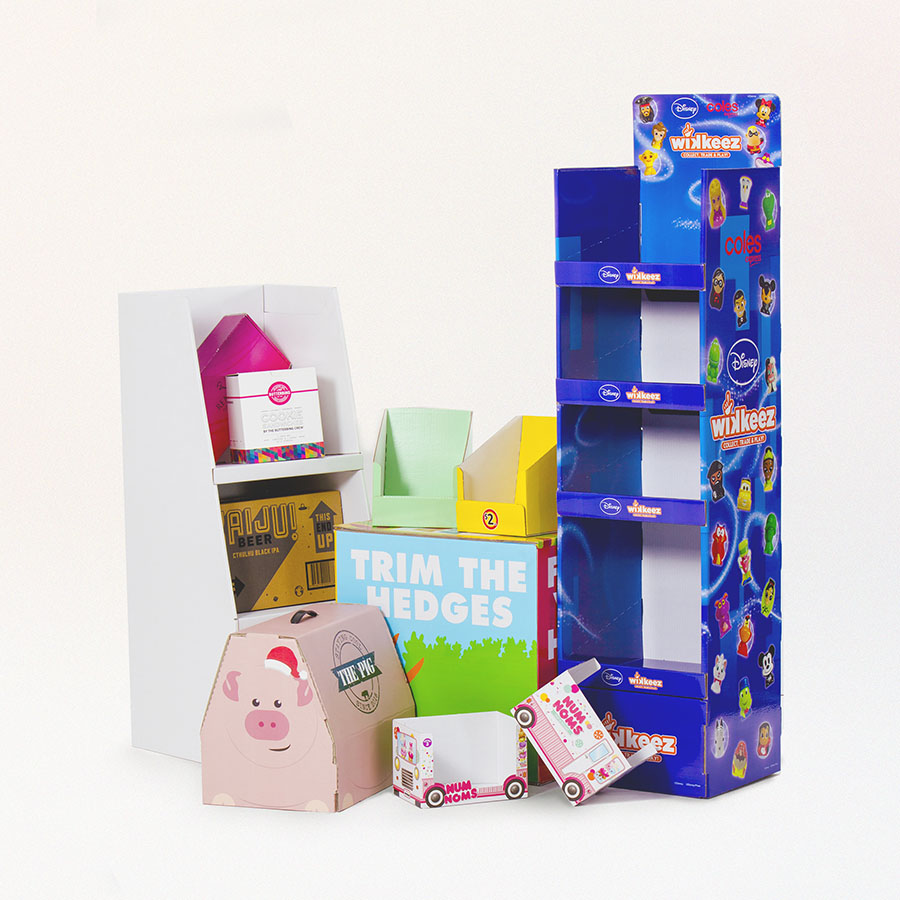
The right cardboard packaging is not just about finding a box with the right dimensions. One of the most important factors to understand is the flute type of corrugated packaging, which contributes significantly to strength, cushioning, stacking performance, appearance, and suitability for transport. The papers used to create each board can also be varied, creating a range of strengths in each flute type. These customised strength options are known as board grades.
B Flute, C Flute, E Flute, and Double Wall (sometimes called twin cushion) boards are designed for different packaging requirements. Each has different characteristics and is suitable for different packaging applications. At Abbe, we manufacture our own corrugated board and can help Australian businesses understand the ideal choice for their products. Our expert team specify flute types, board grades and customise packaging design to suit individual applications, including product weight and storage, branding, protection or distribution requirements.
What is a Flute in Corrugated Packaging?
The flute of corrugated board refers to a wavy, arched layer of paper sandwiched between two liner sheets. It’s these interconnected series of arches that give the corrugated board its structural strength, rigidity, and shock-absorbing properties. Different flute profiles provide different characteristics, with larger, taller flute profiles generally providing more cushioning and stacking strength. Smaller flute profiles offer a thinner construction and a smoother surface for printing.
Flute type is only one part of the equation. The paper weight and strength combination, used to create each board grade, also influences the suitability of packaging. That’s why there is no single ‘best’ flute or grade. The right choice depends on the product, packaging structural design, weight, handling requirements, and the environment the packaging will be transported and stored in.
With over 30 years of expertise in manufacturing corrugated board and packaging in Australia, Abbe can custom design each box and specify the right combination of flute type and board grade to suit a huge range of packaging operations, from the humidity of Far North Queensland horticulture applications, to the rigours of cold-chain and eCommerce logistics.
B Flute: Strong, Versatile, and Suitable for Die-Cut Packaging
B flute is a relatively compact corrugated board profile, generally around 3mm thick. With a narrower flute than C Flute, it’s commonly used in customised, die-cut packaging applications. The flatter surface can also be helpful where branding and printed product information are important.
B flute is a practical choice when you need packaging that combines protection without adding unnecessary thickness. It’s ideal for businesses that need a balance between protection, presentation, and the efficient use of space.
B flute can be useful for:
- Die-cut cartons and specialty packaging
- Retail packaging
- Food and Beverage packaging
- Applications requiring a balance of strength and appearance
C Flute: A Popular Choice for Shipping and Stacking
At approximately 4mm thick, C flute is one of the most commonly used flute types for Regular Slotted Containers (RSCs). C flute has excellent stacking strength, making it well-suited to cartons that need to withstand storage, handling, and transportation.
If your priority is a dependable carton for everyday shipping, C Flute is often a strong starting point. For many businesses, C flute offers a practical middle ground between protection and weight, although the correct board grade still needs to be selected according to the product and application.
C flute can be useful for:
- Shipping cartons
- General-purpose boxes
- Warehousing and distribution
- eCommerce packaging
- Products that require additional cushioning
- Cartons that may be stacked during transport or storage
E Flute: Thin, Neat, and Suitable for Presentation
E flute has a much finer profile, at around 2mm thick, considerably thinner than the B and C flutes, which can be an important factor when storing or packing large volumes of packaging. One of the key advantages of E flute is its smoother print surface, making it ideal for packaging where appearance and print quality are important.
Depending on the product and application, E Flute can provide a useful balance between protection, presentation, and efficient use of space.
E flute may be useful for:
- Retail packaging
- Small cartons
- Lightweight products
- Printed packaging
- Applications where a compact box is preferred
Double Wall: Extra Strength for Demanding Applications
Abbe can combine two flutes to create a Double Wall, or Twin Cushion, board. These double-wall corrugated cardboard sheets are constructed from five distinct layers of paper. Two layers of fluted paper are separated by a liner, with top and bottom liners forming the outer surface. This heavy-duty packaging material provides significantly more strength, rigidity, and crush resistance than standard single-wall boxes.
Double-wall packaging can be useful for:
- Heavy products
- Fragile or valuable goods
- Long-distance transport
- Industrial packaging
- Products requiring additional cushioning
- Applications where stacking strength is especially important
B Flute vs C Flute vs E Flute vs Double Wall
| Board Grade | Approx. Thickness | Key Characteristics | Typical Applications / Benefits |
|---|---|---|---|
| B Flute | ~ 3 mm | Good printing properties; slightly lower stacking strength than C Flute | Mainly used for die-cut applications |
| C Flute | ~ 4 mm | Excellent stacking strength | Commonly used for RSCs |
| E Flute | ~ 2 mm | Thin, with a smoother print finish | Where presentation and print quality are important |
| Double Wall (EB Twin Cushion) | ~ 5 mm | Combines E+B flute; improves board strength and rigidity | Where greater strength and rigidity are needed |
| Double Wall (BC Twin Cushion) | ~ 7 mm | Combines B+C flute; provides additional strength and cushioning | Heavy products or products requiring extra cushioning during transport |
*Approximate thickness based on Abbe’s published material information.
What About Corrugated Cardboard Sheets?
Flute selection is not limited to finished boxes. Businesses can also use corrugated cardboard sheets for a range of protective and packaging applications. Abbe manufactures and supplies a range of corrugated sheet types that can be used as layer pads, dividers, and other protective components.
How to Choose the Right Corrugated Board
There is no universal ‘best’ flute. The right choice depends on your product and supply chain. Rather than choosing a board based solely on thickness, experienced corrugated board suppliers can assess the complete application.
Start with the basics:
- Product weight: Heavy products may require stronger board construction or double-wall packaging.
- Product fragility: Items that are easily damaged may benefit from additional cushioning or protective inserts.
- Storage requirements: If cartons are stacked for extended periods, or contain heavy product, stacking strength becomes particularly important.
- Transport conditions: Packaging travelling through multiple handling points may need greater durability.
- Presentation: For retail products, the appearance and print quality of the outer packaging can be just as important as structural performance.
- Packaging design: The shape and style of the carton can influence which flute and board grade are most appropriate.
Why Trust Abbe
Abbe is an Australian, family-owned manufacturer and supplier of corrugated and cardboard packaging. As one of the leading corrugated board suppliers, we manufacture our own board, giving us greater flexibility in tailoring packaging to individual products, storage, and distribution requirements.
Abbe also offers a broad range of packaging solutions, from corrugated cardboard sheets and cartons to die-cut boxes, trays, dividers and specialised packaging. With over 30 years of industry experience, our team can develop custom structural solutions and prototypes before production.
Talk to our team about your product, packaging requirements, and distribution conditions, and let us help to find a solution for your business.
Get in touch!
- Victoria: (03) 9301 8800
- New South Wales: (02) 9757 7500
- Queensland: (07) 3094 6500